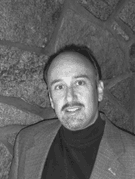
a Writing group of two
Husband-and-wife authors in Westford are partners in the pursuit of fiction
By NANCYE TUTTLE, Sun Staff
WESTFORD
He writes legal thrillers and she writes family sagas.
He edits her and she edits him. Over the years, they've developed tough skins and the ability to accept constructive criticism from each other without getting ticked off.
They're each other's biggest fans and toughest critics.
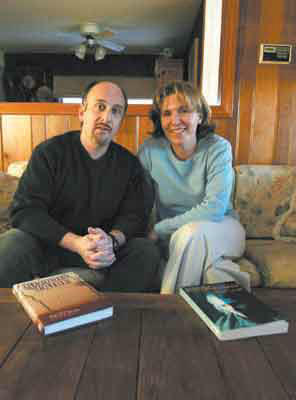
David Brody and Kimberly Scott are also husband and wife. Married for 11 years, they have a life most writers only dream about.
They live in a cozy waterside home on Lake Nabnasset, writing novels and sharing quality time with their young daughters, Allie, 9, and Renee, 7.
It's a pretty fine life, they agree and it only promises to improve as they continue their quest to write exceptional fiction.
Brody, who practices real estate law part-time, recently had his second book, Blood of the Tribe, published by Martin and Lawrence Press of Groton. His first book, Unlawful Deeds, was a Boston Globe bestseller in early 2000.
Blood of the Tribe has garnered local buzz, including an interview on The David Brudnoy Show on WBZ-AM last fall and a front-page story in The Cape Cod Times. And Brody shared The Boston Phoenix's Best Local Author designation for 2003 with Dennis Lehane, author of Mystic River.
"It's been exciting," Brody said during a recent interview.
Tomorrow, he'll be in Lowell from 2-3 p.m. to sign his book at Barnes and Noble Downtown, 151 Merrimack Street.
Blood of the Tribe is set on Cape Cod and delivers a fictional account of what Brody believes could happen once a Mashpee Wampanoag Indian tribe re-files a land claim they first filed in the 1970s. He concludes that $2 billion worth of prime Cape Cod real estate could soon be up for grabs.
"I try to take real legal issues, usually New England-based, and use them as the basis for my novels," said Brody, whose first novel focused on an art heist, based on the theft at the Isabella Stewart Gardner Museum.
Scott, meanwhile, is writing her second novel, a family saga set during the race riots in Boston in the 1970s, with black and white families intersecting.
"My agent is shopping it around," she said.
Her first novel, Papaya Myths, published in 2000, is a family saga with a futuristic twist about a woman living in this era and then in the year 2050.
"Part of the book deals with domestic abuse and its aftermath. I came up with the idea when my daughter was born in 1994 and I spent the summer watching the O.J. Simpson trial while I fed her," said Scott.
A passion for writing united Brody and Scott from the beginning. They met in a bar in Newport, R.I., in the summer of 1989, when Brody had taken time off from his law practice to write a novel.
"I was working as a marketing manager for a travel magazine, and we both were in Newport for the summer," Scott recalled. "He told me he'd quit his legal job to write a novel. I had always wanted to write from the time I was a teen. So it connected us from the start."
Brody never finished that first novel, which dealt with international intrigue.
"I went back to practicing law as a sole practitioner and we lived all over the place, Newton, the Back Bay, the South End," he said.
Their first move to the suburbs took them to Littleton, where they decided to pursue their writing seriously.
"We shared a computer and child care and got an agent, too, which can take a while," Brody said.
While their initial dreams of writing peacefully as their toddler daughters played didn't pan out, they managed to get the first books written and published.
They moved to Westford 5 1/2 years ago, settling into their house on the lake, with a dock in the summer and ice skating in the winter.
With the girls in school now, they each have their own computers and their own writing routines as well.
"I get up and get going," said Scott. "I've had a lot of research with this book and had to plot it out more than my first. I let my characters lead the action, and it's fun seeing them and where they will go."
Brody finds his creative juices flow more freely at night.
"At some point, you become a reporter, reporting what your characters do. I like to let my characters take the lead, too. It's like raising kids. The first eight years you have a lot of control and then you have to let them go a little, like adolescents and teens," he concluded.
|